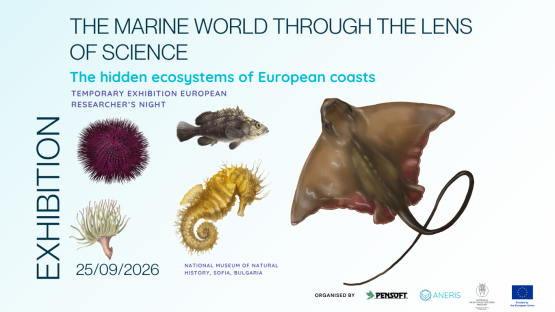
ANERIS exhibition brings the hidden ecosystems of Europe’s coasts to Sofia
A new exhibition exploring the hidden biodiversity of Europe’s seas and the technologies helping scientists observe it officially opens today, Friday, 25 September 2026, at the National Museum of Natural History in Sofia, Bulgaria.
Titled The Marine World Through the Lens of Science: The Hidden Ecosystems of European Coasts, the exhibition is an ANERIS initiative developed in collaboration with Pensoft Publishers, the communication and dissemination partner within the project, and the National Museum of Natural History.
Across 14 bilingual panels in English and Bulgarian, visitors will discover why monitoring marine biodiversity remains a major scientific challenge. Although the ocean supports an extraordinary variety of life, much of it is still poorly understood and may disappear before it can even be documented. Climate change, pollution and increasing human pressure make the development of faster and more reliable monitoring approaches increasingly urgent.
The exhibition introduces ANERIS and its concept of Operational Marine Biology (OMB): an integrated approach combining next-generation sensing technologies, digital infrastructure and collaborative science to support systematic, long-term monitoring of marine and coastal ecosystems.
Visitors will have the opportunity to learn how the project’s imaging technologies use underwater cameras, advanced image analysis and artificial intelligence to observe marine organisms in near real time. The exhibition also presents genomic tools that detect the genetic traces species leave behind in seawater and sediments, enabling researchers to identify marine life that may be difficult to observe directly.
Citizen science is another central part of the exhibition. Through the MINKA platform and BioMARathon campaigns, researchers, divers, nature enthusiasts and local communities can record and share observations of marine and coastal species. These contributions are verified and transformed into valuable scientific information, helping researchers monitor biodiversity across larger areas.
By making these scientific methods accessible to a wider audience, the exhibition invites visitors to look beneath the surface of Europe’s waters and discover how technology, research and public participation can contribute to a better understanding and protection of marine life.
Explore the exhibition panels here: