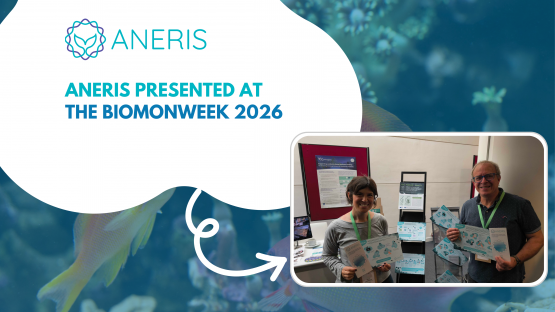
ANERIS presented at the BioMonWeek 2026
The first BioMonWeek took place last week, from 4 until 8 May in Montpellier, France. Co-organised by GBIF, Biodiversa+, Alliance for Nature, BioAgora, and MARCO-BOLO, this inaugural edition welcomed scientists, policymakers, and business representatives to exchange monitoring knowledge, build valuable networks, and drive tangible societal impact in an effort to further support the current global biodiversity crisis.
The event’s programme revolved around 9 key topics, including:
-
Terrestrial monitoring (Land surveillance in focus)
-
Data management for monitoring (Frameworks, data standards, and infrastructures)
-
Monitoring and the private sector (Cooperation with and for non-state-owned enterprises)
-
Marine monitoring (Observing ocean ecosystems)
-
Mass monitoring (Large-scale methods and technologies for monitoring)
-
Monitoring governance (Organisational solutions for improving existing structures)
-
Freshwater monitoring (Spotlight on rivers, lakes, and wetlands)
-
Public policy and funding for monitoring (Science-policy dialogues)
-
Capacity-building in monitoring (Training, tools, and knowledge development)
ANERIS was presented at the conference by representatives of ICM-CSIC, namely project coordinator Jaume Piera and Berta Companys, member of the EMBIMOS Research group. On May 7th, Berta Companys contributed to the session “Citizen science for biodiversity monitoring" with a presentation called “Scaling up marine biodiversity monitoring through large-scale participatory events, the BioMARathons.” In her talk, Berta explained the role of citizen engagement and data accumulated from such participatory events for the conservation and restoration of marine biodiversity. Later that day, Jaume Piera presented during the session “Mobilising marine biodiversity monitoring data.” His presentation focused on the vision behind the ANERIS project, more specifically Operational Marine Biology (OMB) and included some preliminary project results.
The ANERIS project was also featured at BioAgora’s booth along with fellow EU-funded projects, such as OBSGESSION, eLTER, and FORSAID.